Whole-yard drainage planning
Yard Drainage Solutions in Nashville, TN
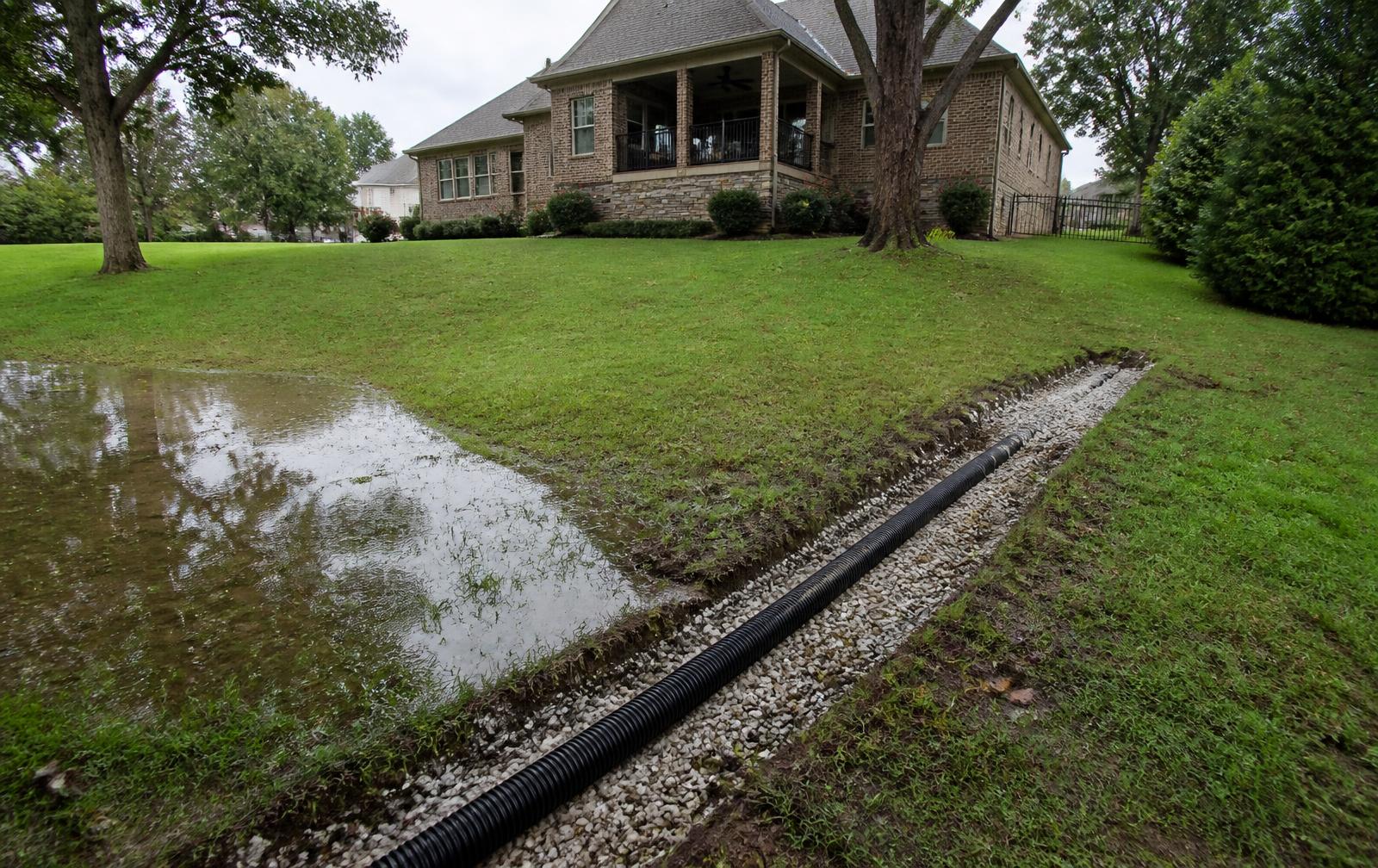
Yard drainage is the whole-property approach to surface water: where rain lands, where it collects, how fast it moves, and where it is allowed to leave. Most Nashville-area yards that stay wet are not suffering from one broken part — they are moving more stormwater than the existing grade and discharge points can carry away.
A useful yard drainage plan starts by separating the water sources. Roof runoff from downspouts behaves differently from sheet flow off a sloped neighbouring lot, and both behave differently from a low spot that simply holds water because there is nowhere lower for it to go.
Symptoms
Signs you are dealing with this problem
- Puddles that sit on the lawn for a day or more after rain stops
- Soft, spongy turf that rutted under mower tires
- Moss, algae or bare mud patches in the same spot every season
- Mulch and topsoil washing across walkways
- Water sheeting toward the house instead of away from it
- Mosquitoes concentrating in one low area of the yard
When this solution fits
- More than one wet area on the property, or a wet area that keeps moving
- Water arriving from an uphill lot, street, or neighbouring property
- A previous single-purpose fix (one drain, one splash block) that did not solve the problem
- Landscaping, patio, pool or turf work planned where drainage must be settled first
How it works
How this drainage work is typically done
- Step 01
Read the water, not just the wet spot
A drainage professional walks the property to identify high points, low points, the slope percentage across the lawn, and the realistic discharge location — a street curb, a swale, a lower rear property line, or a daylight point on a bank.
- Step 02
Separate the sources
Roof water is captured and piped in solid pipe. Surface water is collected at low points with basins or a graded swale. Subsurface saturation is intercepted with perforated pipe in a gravel trench.
- Step 03
Build one connected system
Collection points feed a main drainage line sized for the volume, sloped consistently, and terminated somewhere the water can safely leave without simply relocating the flooding.
- Step 04
Restore the surface
Trenches are backfilled, grades are re-shaped where needed, and turf or sod is put back so the finished yard is usable again.
Local context
How this plays out in the Nashville area
Middle Tennessee gets substantial rainfall spread across the year, and much of it arrives in heavy bursts rather than gentle soaking rain. That combination — high volume over a short window — is what overwhelms yards that drain acceptably the rest of the time.
Many Nashville-area subdivisions were built on rolling terrain with clay-heavy soil over limestone. Clay absorbs slowly, so surface water has to travel rather than soak in. Where the finish grade is nearly flat, or where construction traffic compacted the soil, that travelling water stops and stands.
Lot-to-lot flow is also common in the metro. Where houses sit stepped down a hillside, the lower property inherits runoff from everything above it, and that water needs a deliberate path across the yard rather than a random one.
Related alternatives
- Yard grading
When the yard holds water because the surface itself is wrong, reshaping the grade can be the primary fix rather than adding pipe.
- Drainage swale
On larger lots, a shaped vegetated channel can carry high-volume runoff more affordably than buried pipe.
Questions
Frequently asked questions
Keep reading
Related drainage services
Free drainage estimate
Tell Us What Is Happening on Your Property
Send the details of your drainage problem and your project can be reviewed by a local drainage professional serving your area. There is no cost to submit a request.
- 1Tell us your ZIP code and drainage problem
- 2Add your name and phone number
- 3Get matched with a local drainage professional
Get a Free Yard Drainage Estimate
Tell us what’s happening on your property and request local drainage pricing.
No obligation. Takes less than a minute.
Step 1 of 2