Getting roof water off the foundation
Buried Downspout Drainage in Nashville, TN
A single roof section can send a surprising volume of water to one downspout during a heavy Middle Tennessee storm. Splash blocks and short extensions move that water a few feet — usually not far enough to keep it out of the soil beside the foundation.
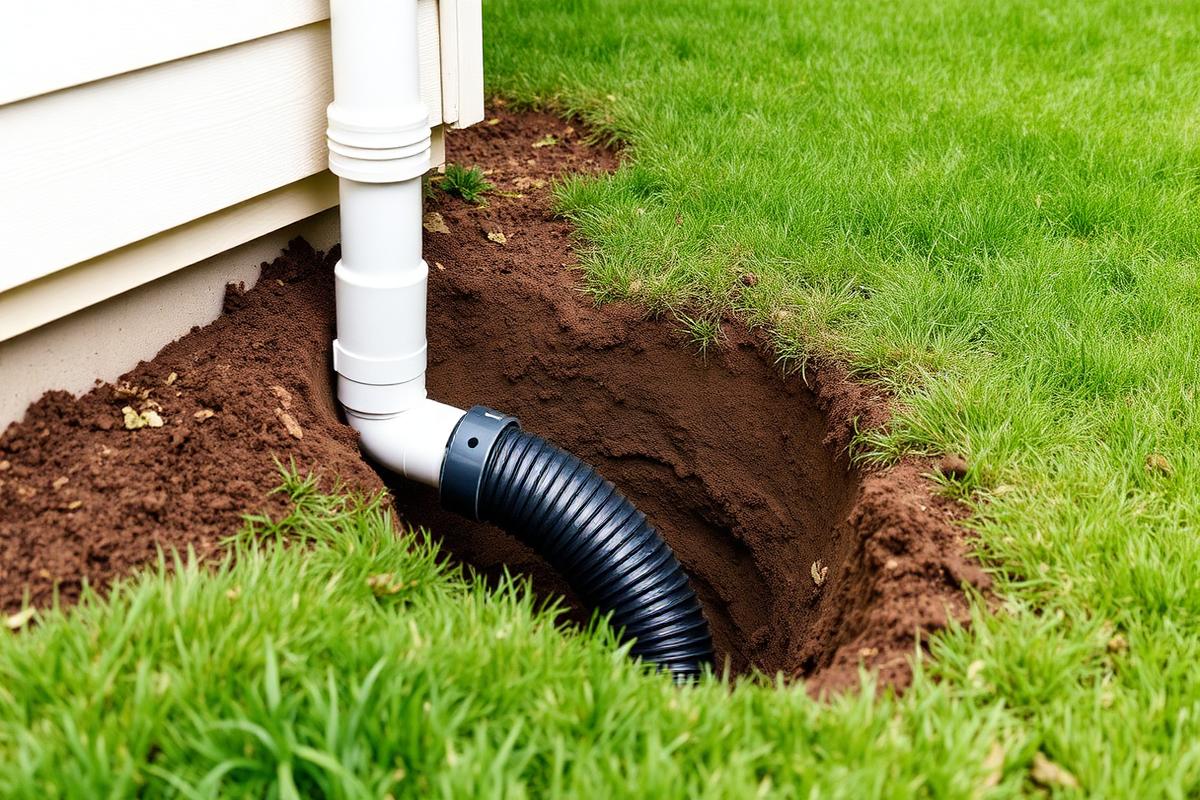
Buried downspout drainage connects the downspout to solid underground pipe and carries the roof water to a controlled discharge point well away from the house.
Symptoms
Signs you are dealing with this problem
- Eroded mulch or soil craters directly under a downspout
- A wet strip along the foundation after every storm
- Splash-back staining on siding or brick
- Water travelling back toward the house along a poorly graded bed
- Crawl space dampness during wet weeks
- Above-ground extensions that get moved every time the yard is mowed
When this solution fits
- Downspouts discharging within a few feet of the foundation
- Landscape beds washing out at roof drip and discharge points
- A large roof area concentrating on a small number of downspouts
- A yard where surface extensions are impractical to mow around
How it works
How this drainage work is typically done
- Step 01
Match pipe to roof volume
Pipe is sized for the roof area feeding each downspout, and solid — not perforated — pipe is used so roof water is not released into the soil along the route.
- Step 02
Trench with fall
The line is trenched with continuous slope away from the house toward the discharge location, deep enough to be protected but shallow enough to keep the fall.
- Step 03
Connect at the downspout
An adapter joins the downspout to the buried line, often with a clean-out or catch basin at the base so leaf debris can be removed rather than carried into the pipe.
- Step 04
Discharge safely
The line ends at a pop-up emitter, daylight outlet on a slope, a basin, or another approved discharge point that does not flood a neighbouring property.
Local context
How this plays out in the Nashville area
Foundation-adjacent water is a common concern across the metro, and roof runoff is usually the largest single controllable contributor. Redirecting downspouts is often the first and most cost-effective step of a broader yard drainage plan.
Nashville-area storms often deliver a lot of rain quickly, so the peak flow at a downspout matters more than the seasonal average. Pipe that is undersized for that peak surcharges and backs up at the gutter.
On flatter lots without a good daylight point, the discharge is typically handled with a pop-up emitter set in a low area of the lawn, positioned so the released water continues to travel away from the structure.
Related alternatives
- Catch basin at the downspout
A small basin at the base of the downspout traps leaves and grit before they enter the buried line.
- Regrading the foundation area
If the ground pitches back toward the house, correcting that grade should accompany any downspout work.
Questions
Frequently asked questions
Keep reading
Related drainage services
Free drainage estimate
Tell Us What Is Happening on Your Property
Send the details of your drainage problem and your project can be reviewed by a local drainage professional serving your area. There is no cost to submit a request.
- 1Tell us your ZIP code and drainage problem
- 2Add your name and phone number
- 3Get matched with a local drainage professional
Get a Free Yard Drainage Estimate
Tell us what’s happening on your property and request local drainage pricing.
No obligation. Takes less than a minute.
Step 1 of 2