Shaped channels for high-volume runoff
Drainage Swale Installation in Nashville, TN
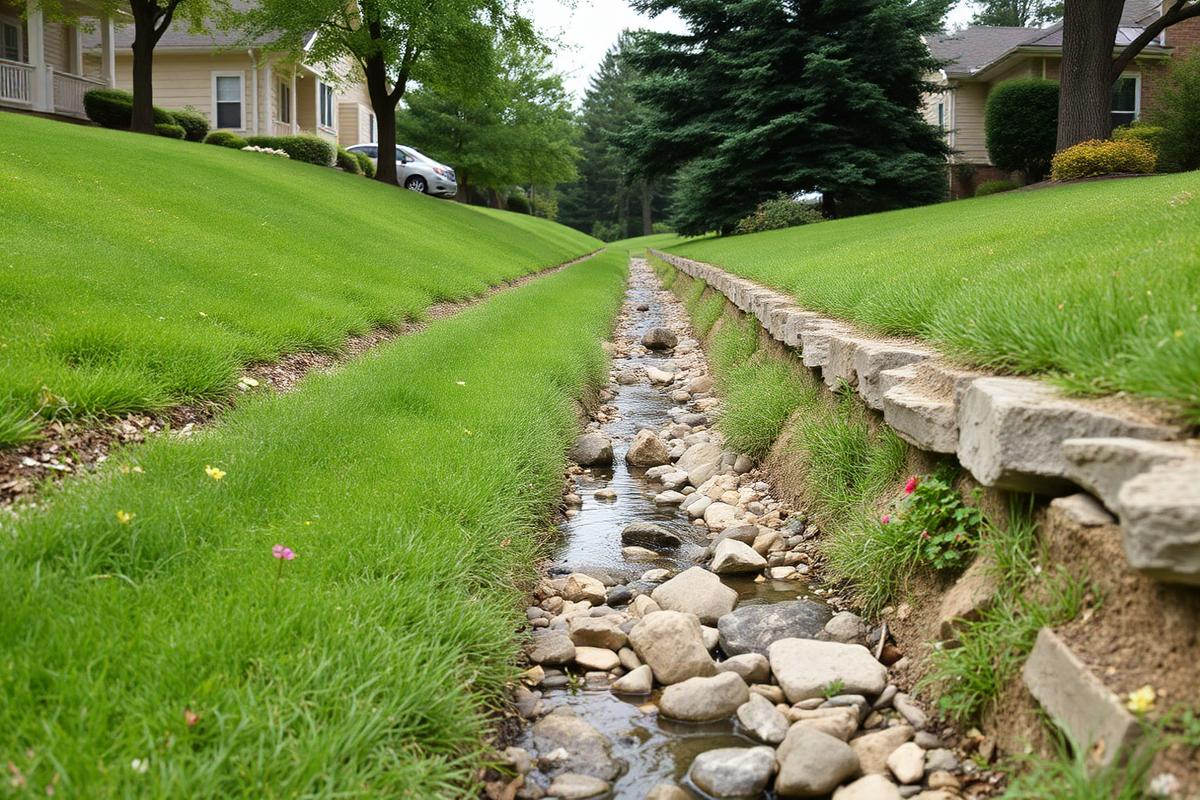
A swale is a shallow, shaped channel that carries surface water across a property in a controlled route. It is not a ditch — a properly built swale has gentle side slopes, consistent fall, and a stabilised bottom that a mower can cross.
Swales are the practical answer when the volume of runoff exceeds what a buried pipe can economically carry, or when the source is a large uphill area rather than a single point.
Symptoms
Signs you are dealing with this problem
- Runoff crossing the yard in a wide, uncontrolled sheet
- A wash or rut forming where water repeatedly takes the same path
- Water arriving from an uphill lot, field, or common area
- Erosion along a property line during heavy storms
- Standing water spread across a broad flat area rather than one hole
When this solution fits
- Larger lots with room to shape a channel
- High-volume runoff that would overwhelm a pipe of reasonable size
- Water that must cross a property rather than be collected and buried
- Sites where trenching depth is limited by shallow rock
How it works
How this drainage work is typically done
- Step 01
Establish the route and fall
The swale follows the natural low path where practical, with continuous grade from the inlet area to the discharge end.
- Step 02
Shape the cross-section
Broad, gentle side slopes are cut so the channel is stable, mowable and does not read as a trench across the lawn.
- Step 03
Stabilise the bottom
Depending on flow velocity, the invert is finished with turf, erosion control matting, or river rock as a dry creek bed to prevent scouring.
- Step 04
Handle the ends
The inlet is shaped to collect the incoming flow without eroding, and the outlet releases water where it can safely continue without flooding adjacent property.
Local context
How this plays out in the Nashville area
Larger lots in Williamson County and the outer parts of the metro often receive runoff from adjacent pasture, wooded slopes or undeveloped ground. A swale handles that volume far more economically than sizing pipe for it.
Where shallow limestone limits trench depth — a real constraint in parts of the region — a surface swale can achieve what a buried line cannot.
Dry creek bed treatments are popular locally because they solve the drainage problem and read as a landscape feature rather than a utility, which matters on properties where appearance is part of the value.
Related alternatives
- Yard grading
A swale is really a specialised grading solution; broad regrading may be enough where flow volume is lower.
- French drain
Where space is tight or the yard must stay flat and open, buried pipe replaces the visible channel.
Questions
Frequently asked questions
Keep reading
Related drainage services
Free drainage estimate
Tell Us What Is Happening on Your Property
Send the details of your drainage problem and your project can be reviewed by a local drainage professional serving your area. There is no cost to submit a request.
- 1Tell us your ZIP code and drainage problem
- 2Add your name and phone number
- 3Get matched with a local drainage professional
Get a Free Yard Drainage Estimate
Tell us what’s happening on your property and request local drainage pricing.
No obligation. Takes less than a minute.
Step 1 of 2