Point collection for low spots
Catch Basin Installation in Nashville, TN
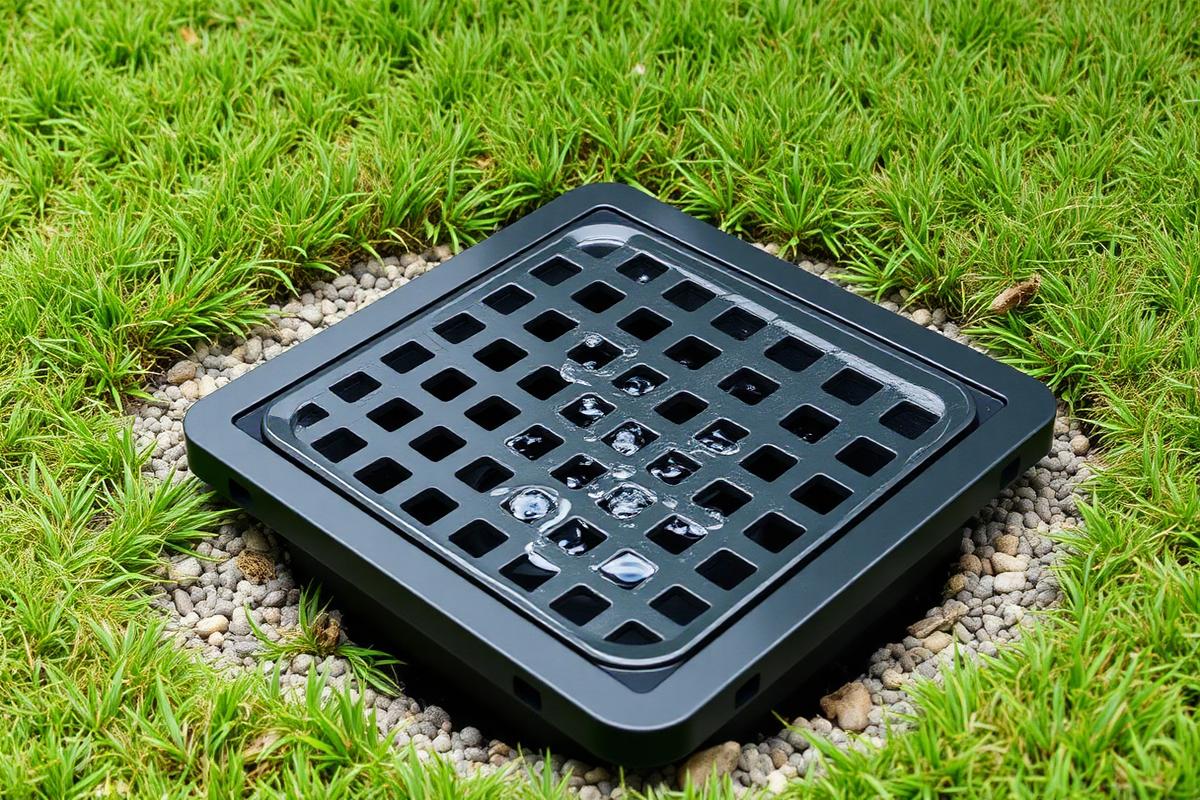
A catch basin is a grated box set flush with the ground at a low point. Surface water falls through the grate into the box, heavier sediment settles in the sump below the pipe outlet, and the water leaves through solid pipe toward a discharge point.
Where a French drain intercepts water along a line, a catch basin collects it at a point. That makes basins the right tool for defined puddles — the corner of a patio, a driveway edge, a sunken lawn area, the base of a slope where flow concentrates.
Symptoms
Signs you are dealing with this problem
- One repeatable puddle in the same spot after every rain
- Water collecting at a patio, walkway or retaining wall edge
- A visible low point where runoff from several directions converges
- Downspout water spreading across the lawn instead of leaving the property
- Mud and silt washing into a hardscape area
When this solution fits
- A clearly defined low point rather than broad saturation
- A place where several runoff paths converge and need one collection point
- Roof or hardscape water that needs to be captured and piped away
- Areas where sediment needs to be trapped before it enters the drainage line
How it works
How this drainage work is typically done
- Step 01
Confirm the true low point
The basin is set at the actual bottom of the depression, not near it. A grate installed a few inches high leaves a puddle behind permanently.
- Step 02
Set the basin with a sump
The box is bedded so the grate finishes flush with the surrounding grade and the outlet pipe sits above the floor, leaving a sediment sump that can be cleaned out.
- Step 03
Run solid outlet pipe
Solid — not perforated — pipe carries the collected water away with continuous fall, so nothing re-enters the soil along the route.
- Step 04
Tie in additional inlets
Downspout lines, additional basins and channel drains can be joined into the same main, provided the pipe size and slope can carry the combined volume.
Local context
How this plays out in the Nashville area
Basins are especially useful on the compact, gently graded lots common in newer Nashville-area subdivisions, where the builder's finish grade leaves shallow bowls between houses that never fully drain.
In areas with clay soils, a basin paired with solid pipe usually outperforms a soak-away approach, because water that cannot infiltrate has to be physically carried to a lower outlet.
Sediment load matters here. Yards with bare slopes, mulch beds, or ongoing erosion push a lot of fine material into drains, which is exactly why a sump-style basin that can be cleaned is worth specifying.
Related alternatives
- Channel drain
For water crossing a wide hard surface rather than pooling at one point, a linear channel captures it more effectively.
- French drain
When the ground is broadly saturated rather than pooling in one bowl, an intercepting trench is the better tool.
Questions
Frequently asked questions
Keep reading
Related drainage services
Free drainage estimate
Tell Us What Is Happening on Your Property
Send the details of your drainage problem and your project can be reviewed by a local drainage professional serving your area. There is no cost to submit a request.
- 1Tell us your ZIP code and drainage problem
- 2Add your name and phone number
- 3Get matched with a local drainage professional
Get a Free Yard Drainage Estimate
Tell us what’s happening on your property and request local drainage pricing.
No obligation. Takes less than a minute.
Step 1 of 2